ReSurfify Wins First Place at the Agritech Innovation Challenge
A university laboratory breakthrough has edged ahead of Africa's fast-growing agritech field — ReSurfify, a Stellenbosch University spinout, wins first place at the Agritech Innovation Challenge at Cape Agritech Connect 2026.
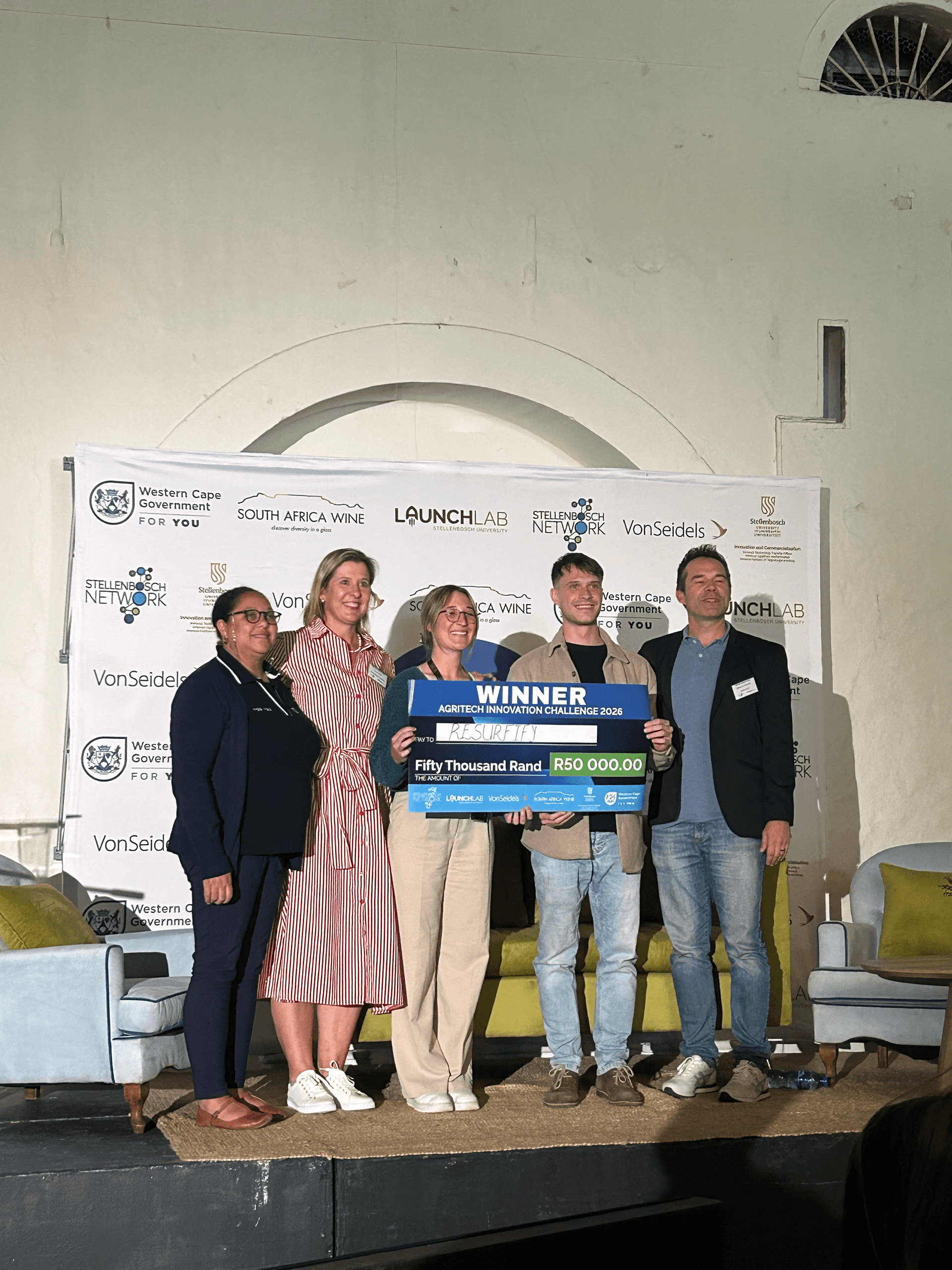
A university laboratory breakthrough has edged ahead of Africa's fast-growing agritech field, underscoring a shift towards deep-tech innovation on the continent.
ReSurfify, a startup emerging from Stellenbosch University, has won first place at the Agritech Innovation Challenge, held during the Cape Agritech Connect 2026 at Nooitgedacht Estate. The competition drew a cohort of high-calibre finalists from across the region, reflecting the increasing sophistication and competitiveness of Africa's agricultural technology ecosystem.
The winning proposition is not another digital marketplace or precision-farming app. Instead, ReSurfify is developing biosurfactants — biodegradable, non-toxic alternatives to petroleum-derived surfactants, produced from virgin or waste vegetable oils. These compounds, widely used in agrochemicals, detergents and industrial processes, have historically depended on fossil-based inputs.
By replacing them with biologically derived substitutes, the startup is positioning itself at the intersection of agriculture, industrial chemistry and climate innovation — a nexus that is rapidly gaining investor attention.
From Farm Inputs to Green Molecules
Surfactants play a critical but largely invisible role in agriculture, improving the effectiveness of pesticides, herbicides and fertilisers by enhancing their spread and absorption. Conventional variants, however, are often environmentally persistent and toxic.
ReSurfify's approach — using renewable feedstocks to engineer biodegradable alternatives — aligns with tightening global regulations and shifting consumer demand for sustainable inputs. It also reflects a broader reconfiguration of value chains, where agricultural by-products are increasingly repurposed into higher-value industrial materials.
In practical terms, the innovation could reduce environmental contamination while opening new revenue streams for agricultural producers supplying feedstock oils.
A Signal of Deeper Change
The result is emblematic of how African innovation is moving beyond platform-based models into science-led, IP-driven ventures.
Over the past decade, the continent's startup narrative has been dominated by fintech and mobility platforms, largely concentrated in hubs such as Lagos, Nairobi and Cape Town. But a quieter shift is underway. Universities and research institutions are beginning to spin out ventures grounded in biotechnology, materials science and climate tech.
South Africa, with its relatively mature research infrastructure, is at the forefront of this transition. Stellenbosch University, in particular, has emerged as a pipeline for commercialisable research, supported by growing collaboration between academia, venture capital and industry.
While ReSurfify ultimately secured the top prize, organisers described the finalist pool as "top-tier", reflecting the rising bar for agritech innovation on the continent.
Africa's Agritech Moment
The timing is notable. Agriculture accounts for roughly a quarter of Africa's GDP and employs more than half its workforce, yet the sector remains under-mechanised and vulnerable to climate shocks. This has created fertile ground for innovation, particularly solutions that enhance efficiency while reducing environmental impact.
Investment in African agritech has fluctuated in recent years amid a broader venture capital slowdown, but climate-linked technologies are proving more resilient. Solutions that address soil health, input efficiency and sustainable processing are increasingly seen as essential, not optional.
ReSurfify's biosurfactants fit squarely within this paradigm — a climate-aligned technology with applications far beyond agriculture, including cosmetics, pharmaceuticals and industrial manufacturing.
From Stellenbosch to Scale
The immediate challenge for the startup will be moving from laboratory validation to commercial scale, a notoriously difficult phase for deep-tech ventures requiring capital-intensive production and regulatory approvals.
Yet the trajectory is clear. If successfully scaled, ReSurfify could position itself not merely as an agritech player, but as part of a global shift towards bio-based industrial chemistry.
For African entrepreneurship, the implications are broader. The victory suggests that the continent's innovation story is entering a new phase — one in which scientific research, sustainability and commercial ambition converge.
In that sense, the significance of ReSurfify's win extends beyond a single competition. It is a marker of where African innovation is heading next.
*Originally covered by The Next Africa — Nomore Kudzedzereka, April 18, 2026.*